Tuesday, February 19, 2008

A God who wanders with us...

On Sunday, we sang the hymn, "Unto the Hills" (LBW #445), a setting of Psalm 121. The opening lines of the hymn:
Unto the hills around do I lift up
My longing eyes;
Oh whence for me shall my salvation come,
From whence arise?
Since I have lived in West Virginia, I have looked at many hilltops, usually from the valley below. Those hilltops can seem threatening as I am hiking or running or biking up them. They are formidable opponents. The psalmist writes from a time when competing gods' altars were placed on the high places. After all, the higher you were, the less distance the rising smoke of your sacrifice had to travel. Hilltops and mountain peaks were sacred places.

But for the psalmist they were threatening. Those hills unto which the eyes were lifted up were homes to the gods who opposed the God of Israel. But this psalm is not a fearful plea. The psalmist is not questioning where God is in all of the confusion of the world. No, instead our writer is continually proclaiming that his (AND our) help (or salvation as the hymn text puts it) comes from the "LORD who made heaven and earth."

Even better, this God, is not one who is relegated to the hill tops waiting for sacrifices. Our psalm paints a picture throughout of a God who is actively engaged with us. Not just during favorable moments, but also during our treks through valleys, when we wonder about our society's competing gods, those powers which lay before us another claim to supremacy, which may threaten, intrigue or repel us. God is there in our midst watching over us.

To do that our God must be a God who travels and wanders with us. This wandering nature of God is precisely why this psalm is a traditional psalm at funerals. There is no journey on which God will not accompany us, even one that leads through the valley of the shadow of death (to quote another psalm). We are forever safe in God's care. Let us remember the closing verse of the psalm and treasure it for here is truly the good news. "The LORD will keep your going out and your coming in from this time on and forevermore (Ps. 121:8)."

Pr. Brian

Monday, February 18, 2008

Weekly calendar...

THIS WEEK AT ST. PAUL (February 17—February 24)

Tuesday 2/19
Bible Study 10:00 AM
Adult Study 7:00 PM

Wednesday 2/20
Soup & Bread Supper 6:00 PM
Lenten Vespers 7:00 PM
Choir Rehearsal 8:00 PM

Friday 2/22
Piecemakers 10:00 AM

Sunday 2/24
Communion Service 8:30 & 11:00 AM
Sunday School 9:45 AM

Do you have something to add? or some questions? Please call 599-0620 for updates or comments.

Second Sunday in Lent

Readings:
Genesis 12:1-4a
Psalm 121
Romans 4:1-5, 13-17
John 3:1-17

This second Sunday in Lent is full of classic passages from Scripture. We hear that Abraham's faith, his trust in God's promise, is reckoned to him as righteousness. Psalm 121 declares that our help comes from God alone, not from the pagan altars located on the hilltops. In John 3:1-17, we hear Nicodemus' conversation with Jesus, where we come to understand the transformative power of baptism, where we are born of water and the Spirit. We also hear in that passage the gospel in miniature, "For God so loved the world that he gave his only Son, so that everyone who believes in him may not perish but may have eternal life."

Powered by simple.myfabrik.com
The player has been changed so that it does not play automatically. Simply click on the bar the top of the player, and the recording will begin.

Tuesday, February 12, 2008

The Human Will as a Beast...

This past Sunday, we heard the words of the psalmist,
9 Do not be like a horse or a mule, without understanding, whose temper must be curbed with bit and bridle, else it will not stay near you. 10 Many are the torments of the wicked, but steadfast love surrounds those who trust in the LORD. 11 Be glad in the LORD and rejoice, O righteous, and shout for joy, all you upright in heart.
This portion of the psalm resonated with something I read of Luther's. In his classic work, On the Bondage of the Will, Luther argues with the great writer Erasmus of Roterdam about the nature of free will, and in the introduction, Luther characterizes the human will as follows.
Thus the human will is placed between the two like a beast of burden. If God rides it, it wills and goes where God wills, as the psalm says: “I am become as a beast [before thee] and I am always with thee” [Ps. 73:22 f.]. If Satan rides it, it wills and goes where Satan wills; nor can it choose to run to either of the two riders or to seek him out, but the riders themselves contend for the possession and control of it.
Here, I think about our lives, being compelled through Satan's bit and bridle of sin to live apart from God. We are brought into a world that is thoroughly bridled so that sin and brokenness seem normal. Yet we do not need that bridle of sin. Christ calls us to freedom in God's steadfast love. In Christ that bit and bridle are removed from us so that we might be led by Christ in the promise of the gospel.

For many in the world, the Christian life seems to be a burden. The Christian life seems to be lacking in freedom and choice. But for ages, Christians have found precisely the opposite that to be led in God's path by Christ, to be a disciple of our Lord Jesus, we find not a burden, but true freedom. We begin to find that we are freed from sin so that we might be freed for worship God and serving only Him (from the gospel reading on Sunday) in many and various ways.

Peace,
Pr. Brian

Sunday, February 10, 2008

First Sunday in Lent

Readings:
Genesis 2:15-17; 3:1-7
Psalm 32
Romans 5:12-19
Matthew 4:1-11

The first Sunday in Lent traditionally assigns the temptation of Jesus as the Gospel reading. Immediately after Jesus' Baptism, the Holy Spirit drives Jesus into the desert to fast and pray. Satan seeks to turn Jesus away from God's desires and turn inward, glorifying himself at the cost of destroying the Father's intentions for the great reconciliation of relationships broken by sin.

Wednesday, February 6, 2008

Ash Wednesday


For Ash Wednesday, a poem by Madeline L'Engle.

Within This Strange and Quickened Dust

O God, within this strange and quickened dust
The beating heart controls the coursing blood
In discipline that holds in check the flood
But cannot stem corrosion and dark rust
In flesh's solitude I count it blest
That only you, my Lord, can see my heart
With passion's darkness tearing it apart
With storms of self, and tempests of unrest.
But your love breaks through blackness, bursts with light;
We separate ourselves, but you rebind
In Dayspring all our fragments; body, mind,
And spirit join, unite against the night,
Healed by your love, corruption and decay
Are turned, and whole, we greet the light of day.

-L'Engle

Sunday, January 20, 2008

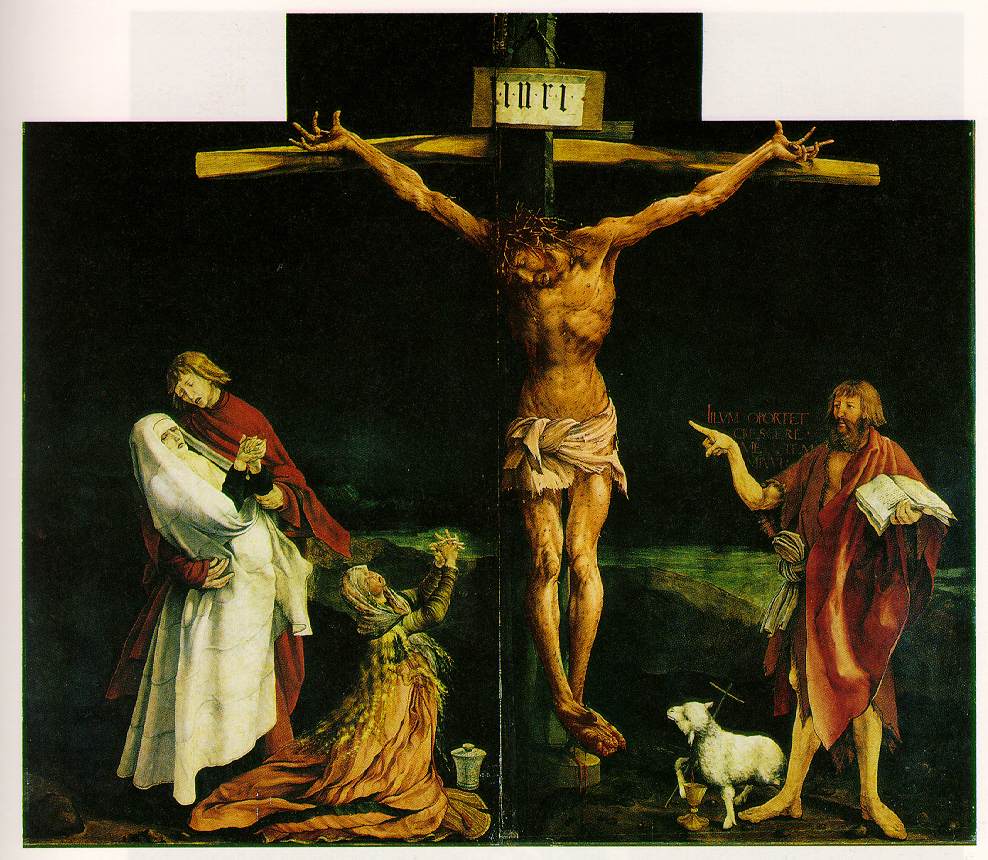
Ecce! Agnus Dei!


The next day [John the Baptist] saw Jesus coming toward him and declared, "Here is the Lamb of God who takes away the sin of the world!" (John 1:29)

Monday, January 14, 2008

Baptism of our Lord


From a sermon by Martin Luther from January 6, 1534:
John indeed saw that the heavens were opened. That was a sign that our Lord God holds baptism dear—baptism that was sanctified by the Son of God himself in his own body. The heavens, previously closed, are now opened, becoming a clear gateway and window for us to see into heaven itself. There is no longer a dividing line between God and us, for he has descended into the [baptismal] water. Isn’t this a great revelation? That is why we call [this festival] Epiphany, because God—Father, Son, and Holy Spirit—has revealed himself with all his angels. The Holy Spirit comes like an innocent dove. Among all birds, the dove is known for its kind heart and lack of anger. Thus, the Holy Spirit presents itself in this friendly form. Here [too] there is no anger. The Son of God, who did not need [to be baptized], reveals himself to us not only as example but also as grace itself. The Father makes himself heard in the voice: “This is my Son, the Beloved, with whom I am well pleased.” It would not be surprising if the heavens and the earth shook before this voice, the speaking of our Lord God himself. If our Lord God spoke, I would fall on my face. But, for all that, the voice comes with nothing but kindness, grace, and mercy, saying, “There you have it: One who has been baptized!” So, do you want to know who [our God] is? He does not come with a sword, or with the noisy clamor of Sinai; he comes with nothing but the images and appearance of friendship. The Son is an innocent man who does more than is required of him; the Holy Spirit comes in a friendly form; the Father has a friendly voice: “I am not sending you prophets or apostles or angels; instead you have my Son, with whom I am completely pleased.”

Read the full sermon here.

Wednesday, January 9, 2008

First Coming

First Coming

God did not wait till the world was ready,
till nations were at peace.
God came when the Heavens were unsteady,
and prisoners cried out for release.

God did not wait for the perfect time.
God came when the need was deep and great.
God dined with sinners in all their grime,
turned water into wine.

God did not wait till hearts were pure.
In joy God came to a tarnished world of sin and doubt.
To a world like ours, of anguished shame,
God came, and God’s light would not go out.

God came to a world which did not mesh,
to heal its tangles, shield its scorn.
In the mystery of the Word made Flesh
the Maker of the stars was born.

We cannot wait till the world is sane
to raise our songs with joyful praise,
for to share our grief, to touch our pain,
God came with Love: Rejoice! Rejoice!

- Madeleine L’Engle

Tuesday, January 1, 2008

Prayers for Kenya...

I received an email Sunday from our medical missionary friends in Kenya. They wrote asking for friends to pray for the people of Kenya in the violent aftermath of their recent election. I am including an excerpt from their email, but removing personal details (names and such) because if found by the wrong people, their lives could be made more difficult.

They write:

Please pray for the safety of the people here in Kenya this week. The presidential elections have not gone well, with polls ending three days ago. The race was close and the old president has declared himself the victor. Things are not at all clear here except that both sides are unhappy. Violence is erupting.

A Kenyan friend [...] called tonight asking for prayer for safety for his family in the slums. They called him to come rescue them as shanties in their neighborhood are torched. There is realistically nothing he can do tonight physically. He has no vehicle Attempting to go get them could very well be suicide. If you run into a mob and you are in a vehicle it is likely to be overturned and torched. A number of Kenyans have died. [Their friend] will try to go and rescue them tomorrow, God willing.

All of us here need prayers for cool heads and safety and peace. Please join us in these prayers, for the people of Kenya and for us.
In this season of Christmas, when the angels proclaim "Peace on earth," let us continue to pray that it may certainly be so.

Grace and Peace.
Pr. Brian